Overview
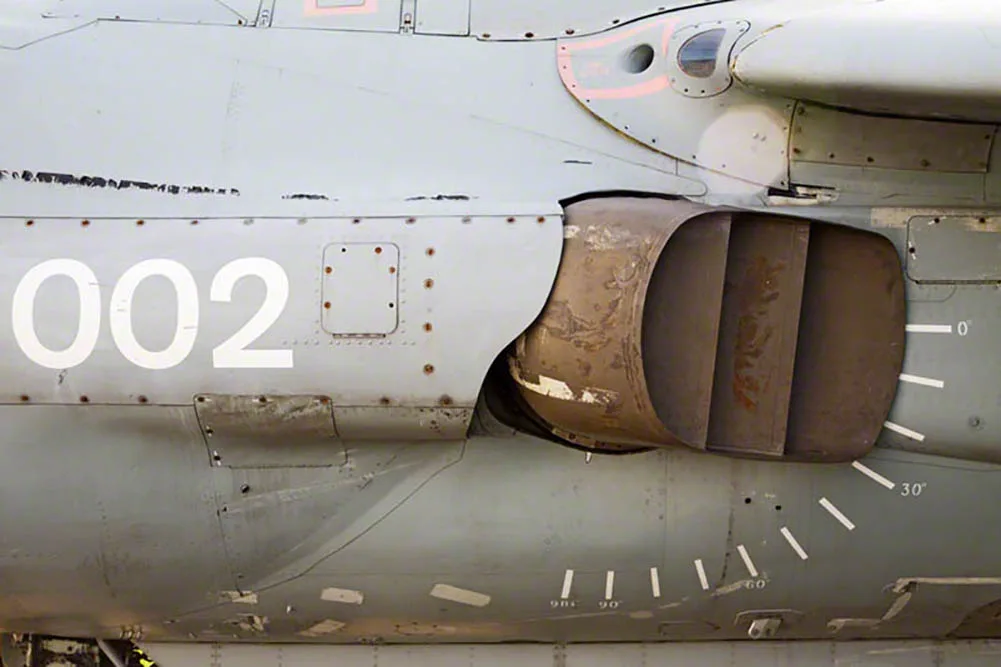
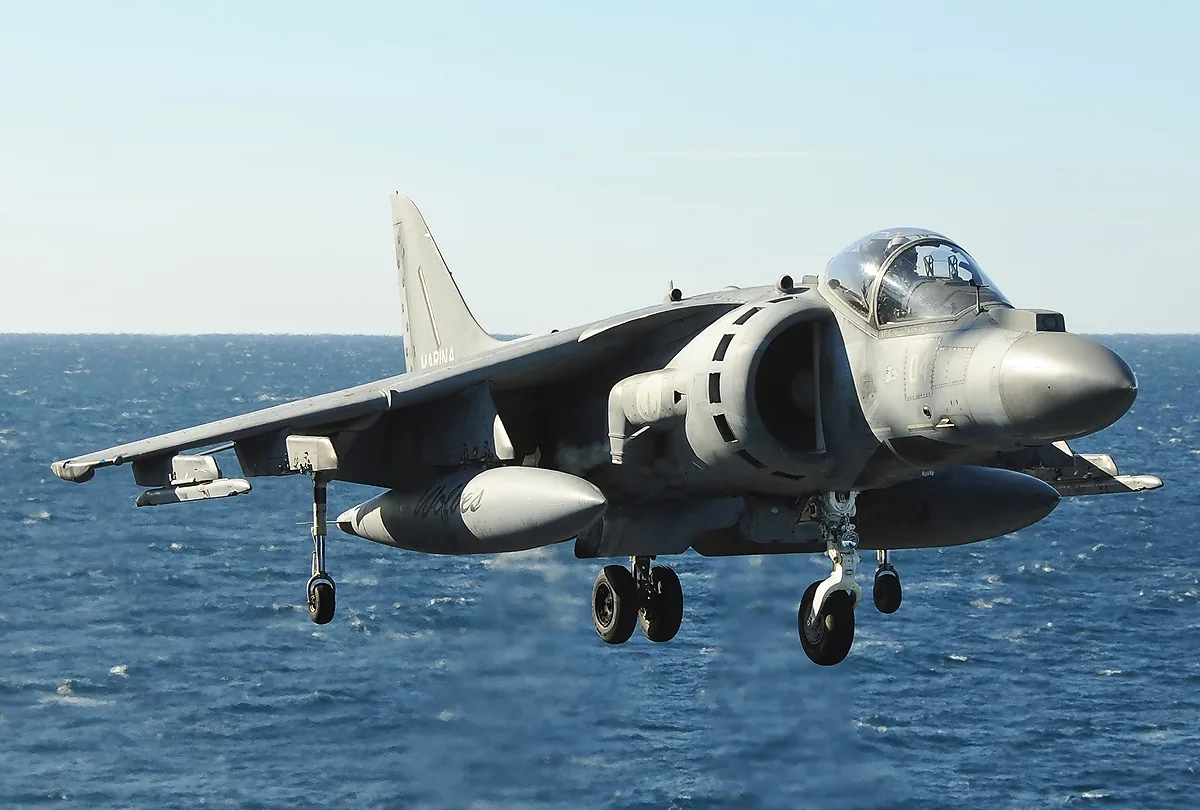
The AV-8B Harrier II is an American-British redesign of the original Harrier, with a larger composite wing and a more powerful Pegasus engine that roughly doubled its payload or range. Like its ancestor, it can take off and land vertically by swivelling four engine nozzles downwards.
The US Marine Corps uses it to support troops from amphibious assault ships and short airstrips near the front. Spain and Italy fly it from small aircraft carriers, and Britain flew its own Harrier GR7/GR9 version until 2010. The F-35B is now replacing it. Specifications are for the AV-8B+.
Specifications
Dimensions
| Length | 14.12 m |
|---|---|
| Wingspan | 9.25 m |
| Height | 3.55 m |
| Wing area | 22.6 m² |
Weights & fuel
| Empty weight | 6,340 kg |
|---|---|
| Max. take-off weight | 14,100 kg |
Performance
| Max. speed | 1,083 km/h |
|---|---|
| Max. Mach | Mach 0.89 |
| Ferry range | 3,300 km |
| Combat radius | 556 km |
| Service ceiling | 15,000 m |
| Rate of climb | 75.0 m/s |
Crew & capacity
| Crew | 1 |
|---|---|
| Hardpoints | 7 |
Powerplant
| Engines | 1 |
|---|---|
| Engine model | Rolls-Royce Pegasus F402-RR-408 |
| Thrust (each) | 105.9 kN |
Figures are compiled from public sources and may be approximate; they can vary by variant and configuration.
Armament
- 25 mm GAU-12 Equalizer cannon pod
- About 6,000 kg of bombs, AGM-65 Maverick and AIM-9 missiles on 7 hardpoints
Photos
Photo 1: Aldo Bidini / Wikimedia Commons · GFDL 1.2
Some text and images come from Wikipedia / Wikimedia Commons under CC BY-SA licences.