Overview
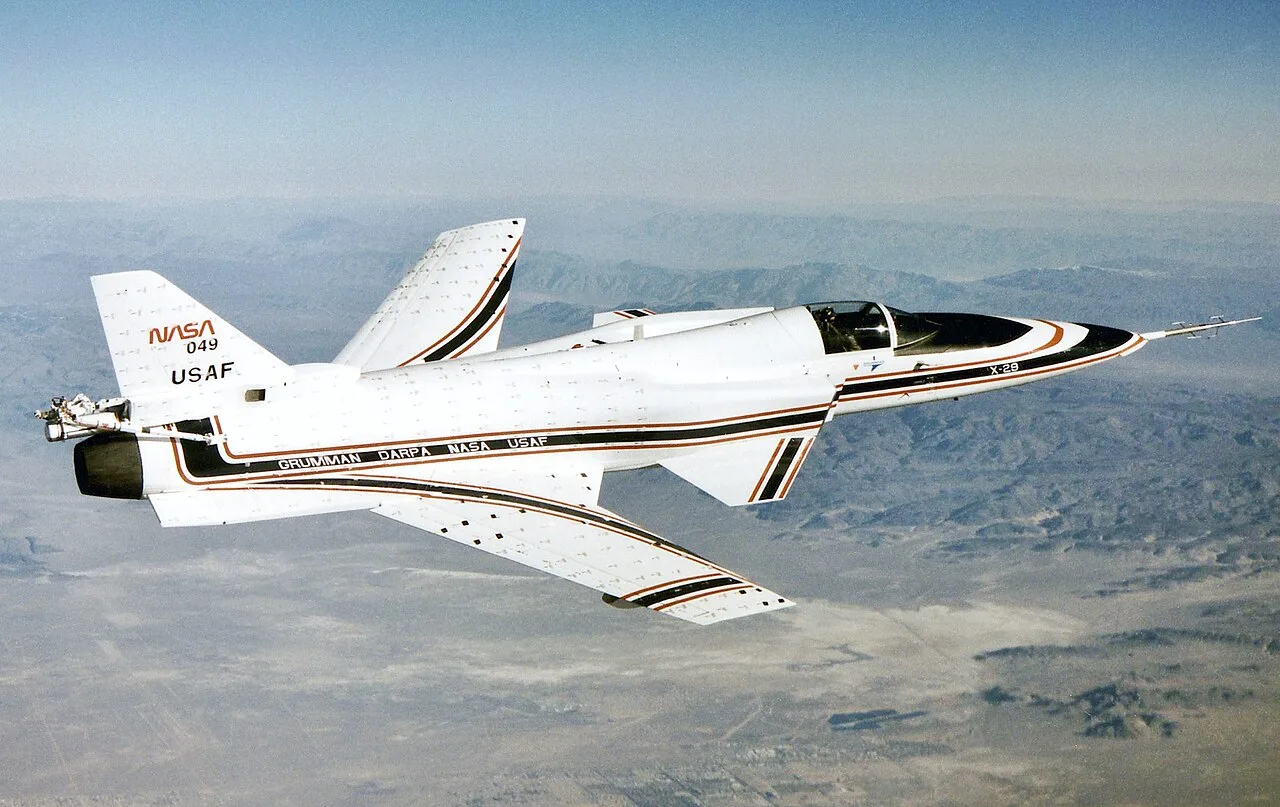
The Grumman X-29 is an American experimental aircraft designed to test a forward-swept wing, canard control surfaces, and other novel aircraft technologies. Funded by NASA, the United States Air Force and DARPA, the X-29 was developed by Grumman, and the two built were flown by NASA and the United States Air Force. The aerodynamic instability of the X-29's airframe required the use of computerized fly-by-wire control. Composite materials were used to control the aeroelastic divergent twisting experienced by forward-swept wings, and to reduce weight. The aircraft first flew in 1984, and two X-29s were flight tested through 1991.
Specifications
Dimensions
| Length | 16.44 m |
|---|---|
| Wingspan | 8.29 m |
| Height | 4.36 m |
Powerplant
| Engine model | General Electric F404-GE-400 |
|---|
Figures are compiled from public sources and may be approximate; they can vary by variant and configuration.
Photos
Photo 1: NASA / Larry Sammons / Wikimedia Commons · Public domain
Some text and images come from Wikipedia / Wikimedia Commons under CC BY-SA licences. Source